Write each page of your wedding website as the answer to one question guests will ask, in two or three short sentences. Copy the lines below for the welcome, your story, getting there, places to stay, dress code, gifts and the day.
At a glance5 points · 10 sections
At a glance
- One page, one question, two or three sentences.
- Keep your story short: how you met, one small detail and the proposal.
- Say what a dress code means. Labels like cocktail mean different things to different people.
- For a country venue, give coach times both ways and warn about phone reception.
- Keep gifts optional, and never post bank details online.
This page is for when you know what goes on your site but not how to say it. It also covers your story, an Acknowledgement of Country and what to print on the invitation.
Not sure which pages you need? Start with what to put on a wedding website, then come back here for the words. That guide also covers who should see your site and what to leave off.
All the examples use a wedding on Saturday 20 March 2027 at a country venue. Swap in your own details. The lines work on any builder, including a wedding website from yourwedding.app.
What should our welcome say?
That you're getting married, that everything is here, and who to ask. Keep inside jokes for the speeches. Pick the version that sounds like you.
We're getting married! Everything you need for Saturday 20 March is here. If anything's missing, just ask us.
We can't believe it's nearly here. Thank you for being part of our lives, and for making the trip. Everything you need for the day is on these pages.
We're getting married! Yes, really. Everything you need is on these pages, so you can save your questions for the dance floor.
Pack your bags! We're getting married in [place] on Saturday 20 March 2027, and we'd love you there. Flights, places to stay and the plan for the week are all here.
Short, warm, funny and for a destination wedding. Pick one.
Should we include an Acknowledgement of Country?
It's optional, and a respectful way to start. Wedshed explains the difference: an Acknowledgement of Country "can be performed by any person", while a Welcome to Country is given by Elders or Traditional Owners (How to do an Acknowledgement of Country at a wedding).
Name the Country for your venue's exact location. Wedshed suggests the AIATSIS map and checking with the local council. Your celebrant can help with the words.
We're getting married on [Nation] Country. We acknowledge the [Nation] people as the Traditional Custodians of this land, and pay our respects to their Elders.
How do we write our story?
Keep it short: how you met, one small detail and the proposal. Three to five sentences is plenty.
Write it together, so it sounds like both of you. Ask before you name friends or family in it, because anyone with your site's address can read it.
We met at a friend's 30th in [suburb] in [year]. One of us spilt a drink, the other helped mop it up, and we talked until the music stopped.
[Number] years, one dog and a lot of flat-pack furniture later, [name] proposed on [a beach walk]. Now we can't wait to celebrate with the people who got us here.
How do we word the getting-there section?
Answer the questions guests will have in the car: how far, where to park and how to get home.
The venue is about an hour from town. Phone reception drops out on the last stretch, so load the map before you leave.
There's free parking on the grass by the cellar door. Planning a drink? Leave the car and take the coach.
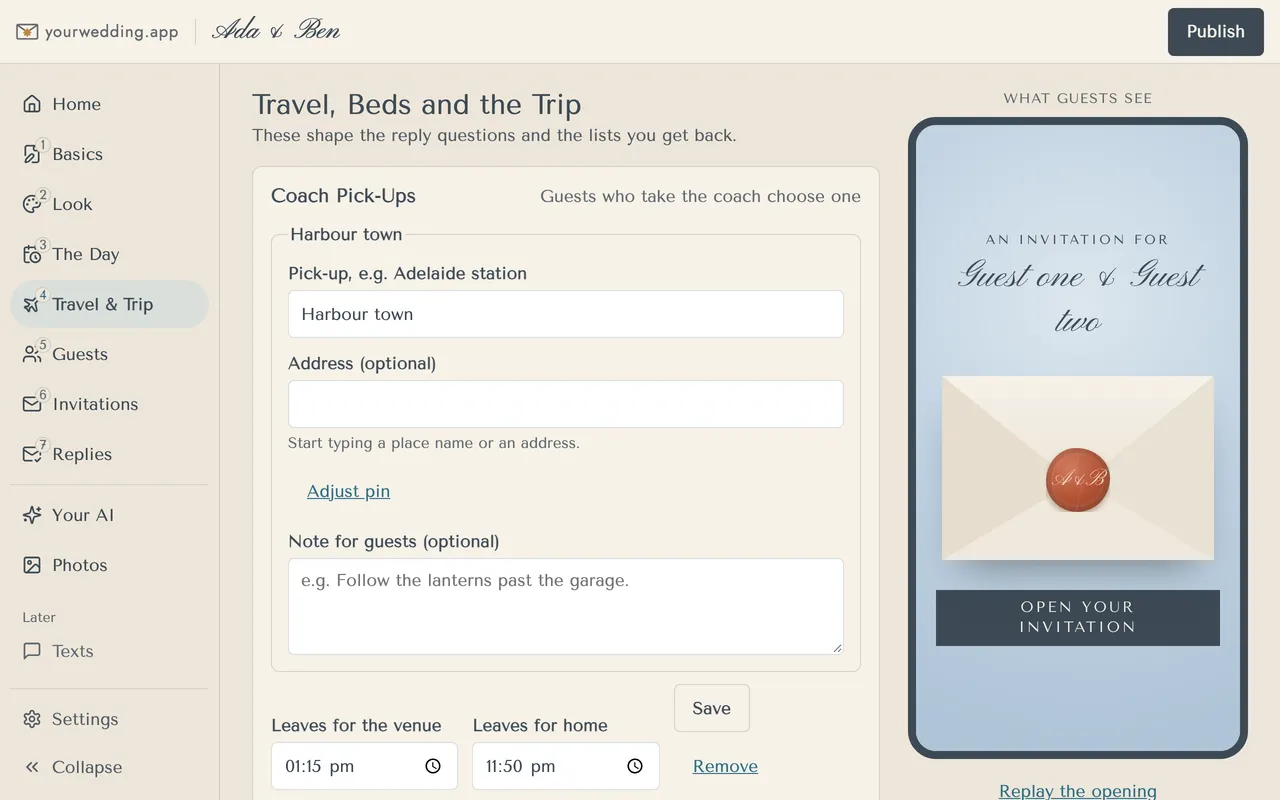
Rideshare is rare out here after dark. The coach leaves the town hall at 2:15 pm and brings everyone back at 11:30 pm.
What do we write about places to stay?
Be honest about what you've arranged. If you haven't held rooms, say so, and still list the closest places.
We haven't held any rooms. These are the closest places to stay. Book early, as March weekends fill fast.
We've got beds at the house for a few of you on Friday and Saturday night. We'll ask on your reply if you'd like one.
For more on stays and coaches, see what to tell guests about a regional or destination wedding.
How do we explain our dress code?
Say what the label means. "Cocktail" and "lounge suit" mean different things to different people, so a line that explains itself saves a lot of messages.
Mention the ground and the weather. A hot afternoon can turn cool after sunset, especially in the country.
Cocktail: a suit (tie optional) or a dress you can dance in. The ceremony's on the lawn, so pick shoes that won't sink.
Smart casual. It'll likely be warm, so bring a hat for the ceremony and a jumper for after sunset.
How do we word gifts or a wishing well?
Keep it short and optional.
Having you there is the gift. If you'd like to give something more, there'll be a wishing well at the reception for our first home.
Please don't bring a gift. We'd much rather see you on the dance floor.
Never post bank account numbers on your website. The Bridal Journey warns that sharing them widely "opens the door to potential fraud" (Are We Just Putting Bank Details on Wedding Invites Now?). More lines, PayID and thank-you notes are in wishing well wording.
What goes in the FAQ and the on-the-day notes?
The answers you'd otherwise send by text on the morning: when to arrive, phones during the ceremony, and who to call. For the questions to cover, see what to put on a wedding website.
Aim to arrive by 3:30 pm. The ceremony starts at 4 pm sharp, and it's a five-minute walk from the car park. Please keep phones away during the ceremony. Our photographer has it covered.
Questions on the day? Call Mel, our MC, on [mobile]. We'll be busy getting married.
For kids and plus-ones, see plus-one and kids-free wording.
How do we point guests to the site from the invitation?
One line near the bottom of the invitation, with the address and what guests will find there. Print the address in full.
Travel, places to stay and the plan for the day: [your website address]
Everything else you need, from coach times to the dress code, is on our website: [your website address]
A short and a fuller version. Print the address in full, so guests can type it.
If guests reply on the site, add the reply-by date as well. See RSVP wording for your website.
A QR code printed on the card is the same for every guest. It can open your site, but it can't be each guest's personal link.
Where does this wording go on yourwedding.app?
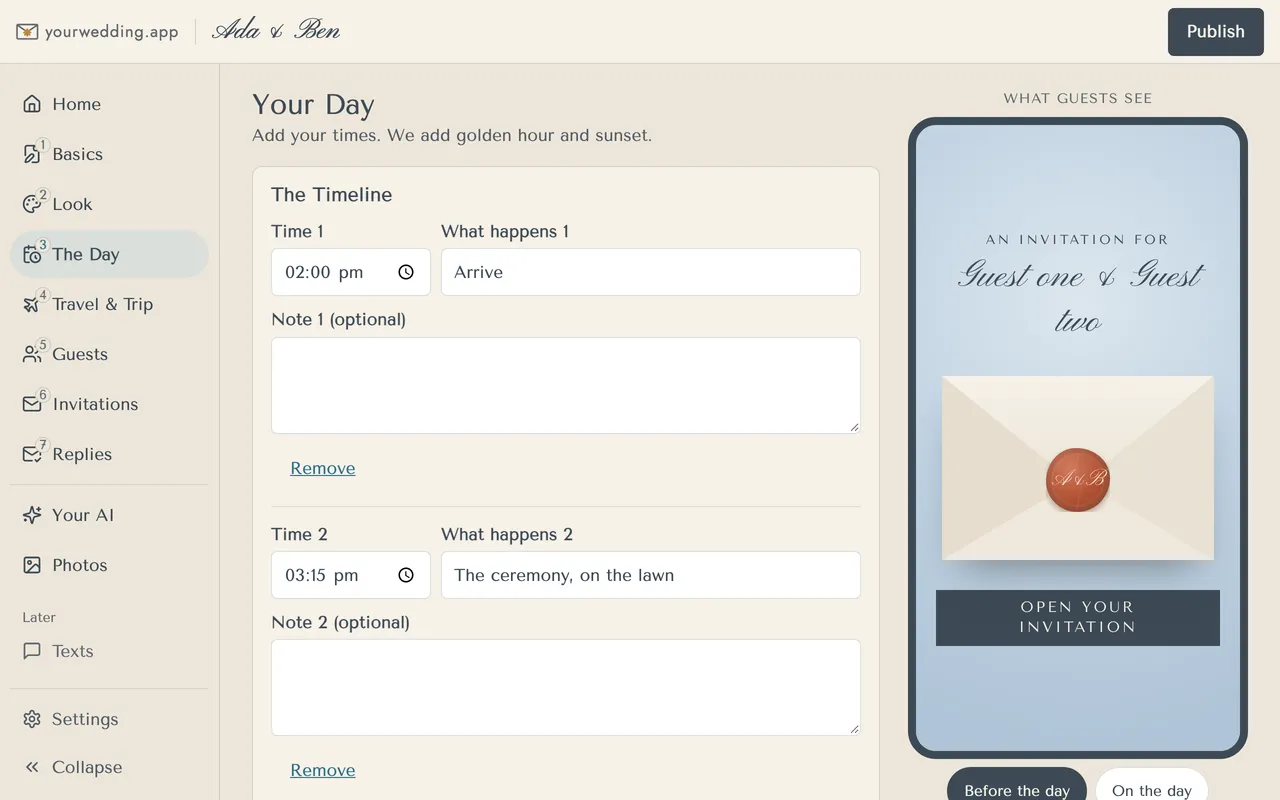
- The Day: your timeline, a short dress code, a note for guests and Good to Know items, each with a heading and a few words (The Day). The welcome or a short story fits the note for guests. Gifts and the Acknowledgement of Country fit well as Good to Know items. There's no separate story page, and no gifts or wishing-well feature.
- Travel & Stay: coach pick-ups, places guests need to find and a Where to Stay section (Travel & Stay).
- Reply questions: ask things like "Joining us for breakfast?" on the reply, not on a page.
On the day, the site leads with what's happening now and next. Read more about wedding websites on yourwedding.app. Still choosing a builder? See the best wedding websites in Australia.
Questions
How long should a wedding website welcome message be?
Two or three sentences. Say you're getting married, thank guests, and tell them everything they need is on the site. Save your story for its own page, if you want one.
Should we put an Acknowledgement of Country on our wedding website?
You can. It's optional, and a respectful way to start. Name the Country where you're marrying, and check it for the venue's exact location. Your celebrant or local council can help with the words.
What does 'cocktail' mean on a wedding website?
It depends who you ask, so spell it out. Say what you mean, such as a suit with the tie optional, or a dress you can dance in. Add anything about the ground and the weather.
Should we list places to stay if we haven't booked any rooms?
Yes. Say plainly that you haven't held rooms, then list the closest places and when to book. Guests would much rather know than search a region they've never visited.
How do we say no kids on our website?
Once, kindly, in your FAQ or a note on the day page, after the invitation has named who's invited. For example: 'We love your little ones, but our wedding is for grown-ups. We hope you enjoy a night off.' Keep it off the front page, and out of bold.